“They” were right

There are some things “they” have said we should do that I have discovered for myself – to my delight – are absolutely true.

Always have an up-to-date resume. Yes! Write your resume then keep it up-to-date. Whether you’re actively job hunting or not, just having this document prepared will make you feel hopeful and in charge of you, the moneymaking machine. I was able to apply for and get a dream job because I had an up-to-date resume available when it was requested on a whim by the hiring manager.

Use the good stuff. You’ve heard this before – burn the candles, wear the silk lingerie, use the good china. Do it! Sure the fancy soaps, expensive perfume and fine old scotch will get “used up.” That is the point. They’re not made to be forgotten in a dark drawer. These beautiful things add luscious sensory joy to life. Don’t deny yourself that.

Send “thank you” notes. When someone gives you a gift or performs a kindness, send a thank you note (even an email is okay). Is that old fashioned? No. Politeness, gratitude and consideration are timeless. Saying thanks reminds you of all you have to be grateful for and esteems the recipient.
adventureGo out and get some fresh air. Magic and adventure won’t come knocking at your door. You have to get out in the world. At the very least you’ll clear your head and get a change of scenery.

I also can vouch for sunscreen, flossing, hugging, playing with children and afternoon naps.

A tale from the winter woods

imagesThis morning I went for a walk on the Iron Horse Trail, a long disused railway track that has been converted to a walking trail and enthusiastically reclaimed by nature. It was a frigid but picture-perfect Christmas morning – silent and white.

In other seasons, the trail is lush with life, home to woodland creatures and birds, dripping with vines, bursting with underbrush, bright with flowers and a dappling canopy of leaves overhead. Today, beneath the white sky, the trail seemed stark and colourless.

But as I walked, I realized just how much was apparent precisely because all the beautiful distraction was gone. Like one of those Magic Eye images, a vibrant picture emerged before me.

I could see the tree trunks and branches, coated in sparkling ice and creaking and clattering in the wind. Squirrel, bird and wasp nests nestled in the branches. There was a maze of footprints and burrows beneath the underbrush.

Lazy snowflakes drifted down. A chickadee swooped past. Red berries, so bright in the white landscape they seemed to be lit from within, drooped on a bush. A raven called and rose above the black branches.

Especially during the holiday season, fraught with pressures to buy, decorate, eat, consume and glitter, how much do we miss because we’re filling our life with stuff? Are we comfortable stripping back our lives? Are we okay with what we might see and hear if we pared back the clutter?

I suspect that if we did, like the winter woods, what at first might feel empty and lifeless would reveal a vivid, hidden world.

On light and darkness – a guest post by Kathye

I asked my friend, Kathye, who is a cool, quirky gal and a professional writer to write a guest post for the winter solstice.

The other morning, I woke up when it was still dark out. I went downstairs, flipped on the light in the living room, and suddenly it seemed like Christmas morning. We had just decorated for the season the day before, and the lights on the window and the tree were plugged into the same outlet as the lamp in the living room. It made me smile, maybe even glow a little.

It also got me thinking. The tradition of Christmas lights started with putting candles on Christmas trees in Germany – a nation that experiences cold, dark winters. It is our nature as human beings to try to bring light to the darkness.

What we sometimes forget is that it’s the darkness that makes us seek ways to light it. If the days weren’t so short, if the winter wasn’t so long, we might not feel the need to celebrate in the middle of it. It’s hard to stand defiant against the darkness when the darkness is unremarkable.

earthriseThe same is just as true in a metaphorical sense. Sometimes it’s in hardship that we find our strength, our courage, our hope… our humanity in all its beauty. There are countless examples throughout history of people pulling together, standing up in the face of evil or hardship – and seeing the humanity in the enemy, as in the case of the Christmas Truce in the first World War.

When darkness looms, we have a choice. We can let it engulf us, bring us down, make us gloomy. Or we can chase it back and turn on the lights.

On the shortest day of the year when the night is so long, don’t curse the darkness – light a candle. Look at it as an opportunity to shine.

—-

Kathye has a blog too!  Check it out at http://kathyesguideto.wordpress.com/

My birthday story

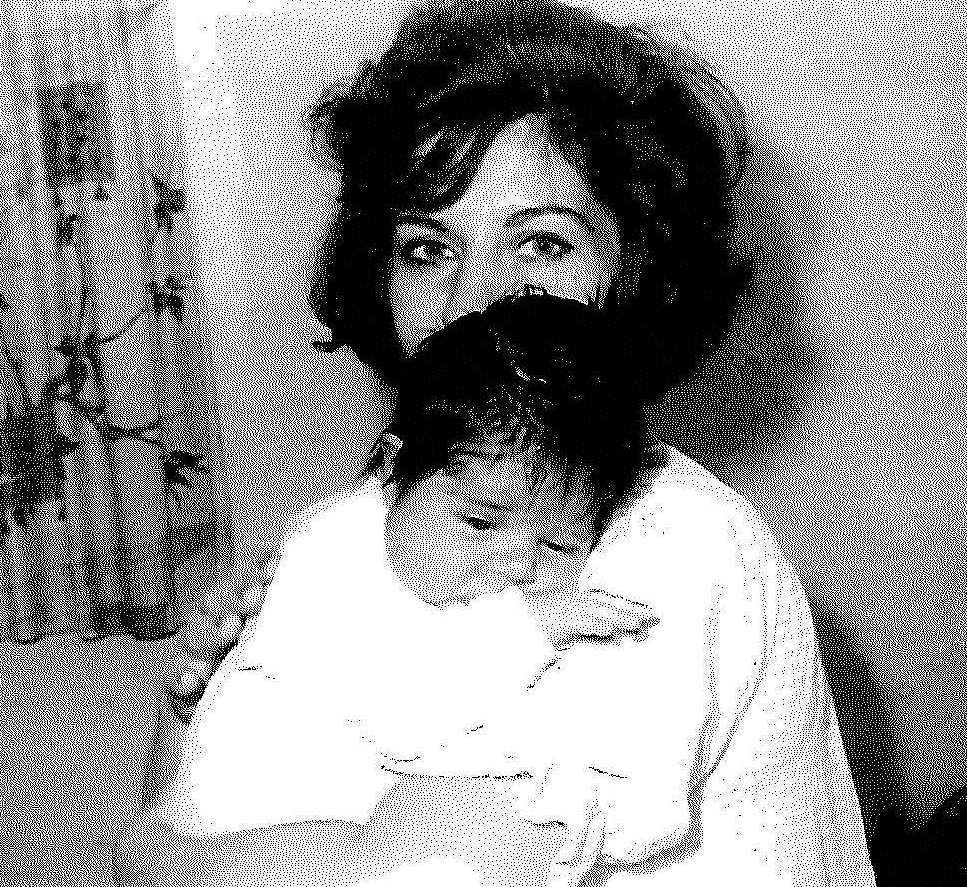
Every year on my birthday my mother would announce “I remember the day you were born….” and she would launch into what I came to think of as my birthday story. It was a story just for the two of us to share. She’d recall the weather (it was snowing), having contractions as she served my brother and sister breakfast before sending them to school and telling my father not to dawdle coming home from work because “the baby was coming.” I’d hear how he was indeed late, how she wanted to stop to buy magazines on the way to the hospital but didn’t have time to read them because I was so impatient to be born.

MomandMeOn my last birthday before my mother died, I went to visit her. She was very ill and her mental facilities were spotty. I told her it was my birthday, but she had forgotten. I asked her to tell me my birthday story. Frustrated with her own lack of comprehension she asked me crossly “what are you talking about?” Even when I prompted her, she just shook her head, not recalling what my birthday story was. Returning home, I realized bleakly that I would never hear my birthday story again. A part of me felt diminished.

On my first birthday after my mother’s death, my sister, Carla, who is seven years older than I am, took me out for the day. As we were driving, and completely out of the blue, she said “I remember the day you were born. The weather was just like this….” And then she told me about waiting with our brother and father for the call from the hospital, and how happy she was when she found out mom had had a baby girl.

I listened in stunned, joyous disbelief. My birthday story wasn’t gone! This was my birthday story from another perspective – a version that had never been told before. And with its telling that little part of me that I thought was diminished forever was restored.

Thank you for the birthday story, Carla. Happy birthday to me!

The most valuable commodity

time2Time. Valuable because it’s irreplaceable. The time that’s gone is gone. You can’t grow or earn more. You don’t even know how much you get in a lifetime. I recommend investing the time you do have for the greatest return.

Know how long it takes to do things. Does MapQuest say your morning commute is only 15 minutes but in fact it’s 30 because you’re always stuck in traffic? How long does it take you to complete household chores? Can you really pack for vacation in 10 minutes? Once you know what the demands on your time are, you can organize and prepare.

Get organized. Know your priorities and what’s most important to you. Develop a system for keeping your home and work life running smoothly. There are a million formal and informal organizing systems out there. I use Franklin Covey and, for longer or more complicated tasks, determine the critical path. Find something that works for you. You’ll save yourself a fortune in time and lost opportunities.

Plan and prepare. Know what you’re going to be doing and where you’ll be in a day. Remember Home Ec. class? The teacher taught us to read the whole recipe first before doing anything. Make sure you have the ingredients and equipment you need. Know what steps you’ll need to follow and what to do first and how much time the whole cooking process should take. Do the same with the recipe for your day.

I’ve been teased because I have my lunch prepared and my outfit ready for the next day. People say things like “Must be nice. I’m just too crazy busy to do that.” Is that so? Those tasks have to get done. I can either do them the night before or in a mounting, messy frenzy the next morning. I know which I prefer and consider the night-before prep as a sound investment of my time and a set up for my own success. And who can argue with success?

The Greek chorus of your life

Dramatic plays of ancient Greece included a Greek chorus – a group of masked performers who commented on the action taking place on stage. Very often this chorus of voices would express horror or warnings– “Don’t enter there!” – or revealed characters’ hidden motivations and feelings that the audience might not otherwise be aware of.

The concept of a Greek chorus always amused me. The collective reactions of a group of masked GreekChorusfigures sucking in their breath, moaning, jeering, warning and commenting on a character’s activities seemed so ridiculous.
But isn’t that exactly what we deal with when we cater to the dictates of society? Daily we are told to fit in, to conform, and especially as women to be nice and not rock the boat. We get approval and are rewarded for not being “weird” or “difficult.”

Television and magazines instruct us how to look, smell, groom, eat and behave. Advertising manipulates us to want certain goods. The media news tells us only what they want us to know. These are today’s Greek chorus.

We may not be conscious of this modern Greek chorus but that only makes it more effective. Once you become aware of the chorus and acknowledge its effect on you, you can challenge it.

Will you conform to its messages? Will you abide by its dictates? Will you continue to do what’s easy and pleasing for others? Or are you the hero of your own play, writing the action and plotline to suit your best self?

A little princess

A Little Princess, by Frances Hodgson Burnett, was one of my favourite books as a child. It’s the story of Sara Crewe, a beloved and pampered child who is suddenly orphaned and left destitute. When they realize she is penniless, the other students and teachers of her boarding school treat Sara cruelly, but Sara never loses her dignity or kindness. It was a story that sang to my soul.

“Whatever comes,” [Sara] said, “cannot alter one thing. If I am a princess in rags and tatters, I can be a princess inside. It would be easy to be a princess if I were dressed in cloth of gold, but it is a great deal more of a triumph to be one all the time when no one knows it.” Little-Princess-main

Sara Crewe showed me that I too could be a little princess no matter what the condition of my physical world because being a true princess is about nobility of spirit and heart.

It’s easy to think the lessons espoused in this book, which was published in 1905, can’t be applied today. Too often, being a princess now means pouting and having royal temper tantrums, bullying and disdaining others who don’t have the latest glitter or tutu, assuming a haughty attitude and treating people as if they were indentured servants. Our society has Bratz dolls and “mean girls” and tiaras for everyday wear.

But, Frances Hodgson Burnett wrote her book precisely because meanness, tantrums and haughtiness were rife in her day too. Her readers could relate to these sorts of behaviours and were enchanted by Sara Crewe who, through goodness of heart and strength of character, rises above adversity and is richly rewarded for it in the end.

We choose the type of princess we will be.

Happy birthday to Frances Hodgson Burnett – born November 24, 1849.

If it’s not yes, it’s no.

Sometimes it’s just that simple. If you’re waffling and wavering on a decision, gauge what your gut is saying. If you’re not getting a resounding and sincere “yes” then your answer is “no.”

Here’s an example of what I’m talking about. Consider this question.

Will you marry me? If the answer isn’t yes, it’s no. C’mon… are you going to answer “maybe” or “yes, but …”?

Or how about this example.

Do you love him/her? If it’s not yes, it’s no. Love may not be unconditional, but you’re either in or you’re out.

If your gut doesn’t say “yes”, or better “HELL YES!”, then it’s no. Go with that.

Just wonder

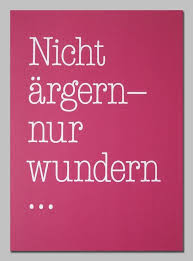
“Nicht ärgern, nur wundern.” My mother kept a plaque in the kitchen with that phrase on it.  It translates from German to Don’t be angry, just be amazed ” according to Google Translate.

Let’s ignore the creepy fact that this phrase was also the message left by German soldiers on the destroyed town hall of Péronne during World War I. I just found that out while researching this blog post. Eeeeesh.

No, no. I will assume that my mother, born well after WWI and a peace-loving and curious person by nature, was not harbouring any dark, pugilistic patriotism for the country where she was born.

NichtArgernIndeed, when I asked her as a child what the plaque meant, she translated it as “Don’t get angry. Just wonder.”

Wonder at what’s going on with the people involved in a conflict.

Wonder at the differing points of view.

Wonder what each person’s “truth” about the situation is.

Wonder if there’s another way to view the problem.

Wonder if you can find an alternate solution.

Wonder why you are upset. What’s pushing your buttons? What are you really afraid of? Anger is rooted in fear of something: fear of rejection, fear of betrayal, fear of loss, fear of pain, fear of being misunderstood.

Stopping and asking “I wonder….” is a simple but effective way to increase your self-awareness and empathy for others and keep an angry situation from escalating.

The squirrel and the sparrow – what would you do?

Yesterday while walking to work I saw a squirrel get clipped by a car. The little creature wasn’t killed but was left in the road writhing and wriggling. It was agonizing to watch. Cars passed by, swerving to miss the squirrel. Other pedestrians didn’t seem to see what was happening.

I spotted a man’s ski glove sitting in a bush. I put it on and during a lull in the traffic went and picked up the squirrel. I placed him on a pile of leaves by a tree and he lay still at last, panting hard, his mouth open and his eyes half closed. I didn’t know what to do.

Once when I was very young, a sparrow fell into our fireplace. By the time my father got the bird from the fire, it was badly burned. My parents took the sparrow up to the kitchen and had a murmured discussion. I stood behind them agitated, shifting from foot to foot. My father took a heavy-handled knife from a drawer and smacked the sparrow sharply on the head with the handle. I started screaming “What are you DOING??” My mother turned around and said gently but firmly “This is the right thing to do. It’s too badly hurt. We’re stopping its suffering.” It was one of the rare times I saw my parents work as a team and I knew with certainty that they were doing the right thing.

But I didn’t have a heavy-handled knife or even a rock to put the squirrel out of his misery. I don’t know how to wring an animal’s neck and was afraid of botching the job. I said a prayer for the squirrel and encouraged him to go to heaven. It occurred to me that my looming over the squirrel was frightening, not comforting to him. So feeling helpless, I stood up and continued on to work.

Should I have found a way to kill the squirrel or is it better he died in his own time? Would it have been kinder to have left him in the road and hoped a car finally hit him? Is it possible the squirrel recovered? I haven’t gone back to the spot to see if he is still there (I can’t bear to).

What would you have done?